Point 7.- About the formula to solve second degree equations
I)
 = 0
So II)
 = 0
So III)
 = 0
So IV)
 = 0
So V)
 =
 = 0
So VI)
 multiplied by
 = 0
So VII)
 multiplied by
 = 0
So x =
 (FOR
 different from zero)
Remember:
 is the symbol of empty set.
IF
 = 0,
 multiplied by
 is equal to
 multiplied by
 , which is equal to
 . So, in the equation
 multiplied by
 = 0 (FOR
 = 0), and on the basis that empty set multiplied by empty set results in every number (besides empty set. Read part 3-C point 6), x is every number for the multiplication is always empty set multiplied by empty set, which results in zero as well as it results in every other number (with every combination of numbers for a, b, and c such that
 = 0,
 multiplied by
 is not really equivalent to
 ; the first expression results in a particular number with x being numbers of all numerical values whereas the second expression results in a particular number with x being numbers of only one or two numerical values). So the equation
 multiplied by
 = 0 (FOR
 = 0) shouldn't be useful to find x in the equation
 = 0 and, as a general equation, to obtain the formula for solving second degree equations for
 = 0. But it's possible to obtain the number x INDIRECTLY through a "detour" in the reasoning. In point V, there is the equation
 = 0. In this equation, in order that x may be a number,
 (the discriminator) has to be different from zero. If
 is equal to zero, x is empty set for
 is equal to
 , and there is no number x with which
 results in zero for there is no multiplication of two numbers equal to each other which results in zero (if d is a number, dxd is always different from zero). we know that, in
 = 0, x is a number (unless
 is smaller than zero), therefore, if
 is equal to zero,
 and, therefore,
 are not always equal to
 ; they are different when
 is equal to zero.* Therefore, in order to solve the equation
 = 0 (for
 = 0), you have to find the number which is x in the difference
 , which is -b/2a.
THEREFORE, if
 , x =
 , and if
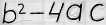 = 0, x = -b/2a.
----------------------------
*Note that
 , which is equivalent to
 , is not always equal to
 for, when b is equal to zero, the two terms
 are equal to zero multiplied by zero, and the two numbers of every one of the infinite combinations of two numbers in which the two terms result are not always equal to each other. For example, for b = 0,
 -
 , which is equal to 0x0 - 0x0, is equal to 5 - 5, (-3) - (-3), 0.73 - 0.73, etc, but is also equal to 3 - 5, -103 - 42,
 - 20/7, etc.
I think the case of the formula to solve second degree equations may seem controversial for it, the formula, help solve the equation in almost every case in the context of conventional Mathematics, but note that, at least and even in that context, the formula is not useful when a is equal to zero unless b and c are equal to zero too. So the formula x =
 is not really a general formula, even in the context of conventional Mathematics.
I'll express another consideration about the formula in the context of what, to me, is a truth, which is that zero multiplied by zero results in every number except zero. Note that when b is equal to zero and c is different from zero,
 is equal to the set of all numbers, and when b is equal to zero and c is equal to zero too,
 is equal to the set of all numbers EXCEPT zero (for a different from zero). When b is equal to zero and c is different from zero, x, in the equation
 = 0, is equal to the square root of -c/a (for a different from zero), and when b is equal to zero and c is equal to zero too, x is equal to empty set because there is no number x with which
 is equal to zero (though, if x = 0, the expression is ax0x0 + 0x0 + 0, which is equal to the set of all numbers, including zero). So there are no equations= 0 for b = 0 and c = 0 (for a different from zero). In both cases, x is different from
 .

